
How Professional Video Editors Think: 9 Lessons From 40,000 Hours
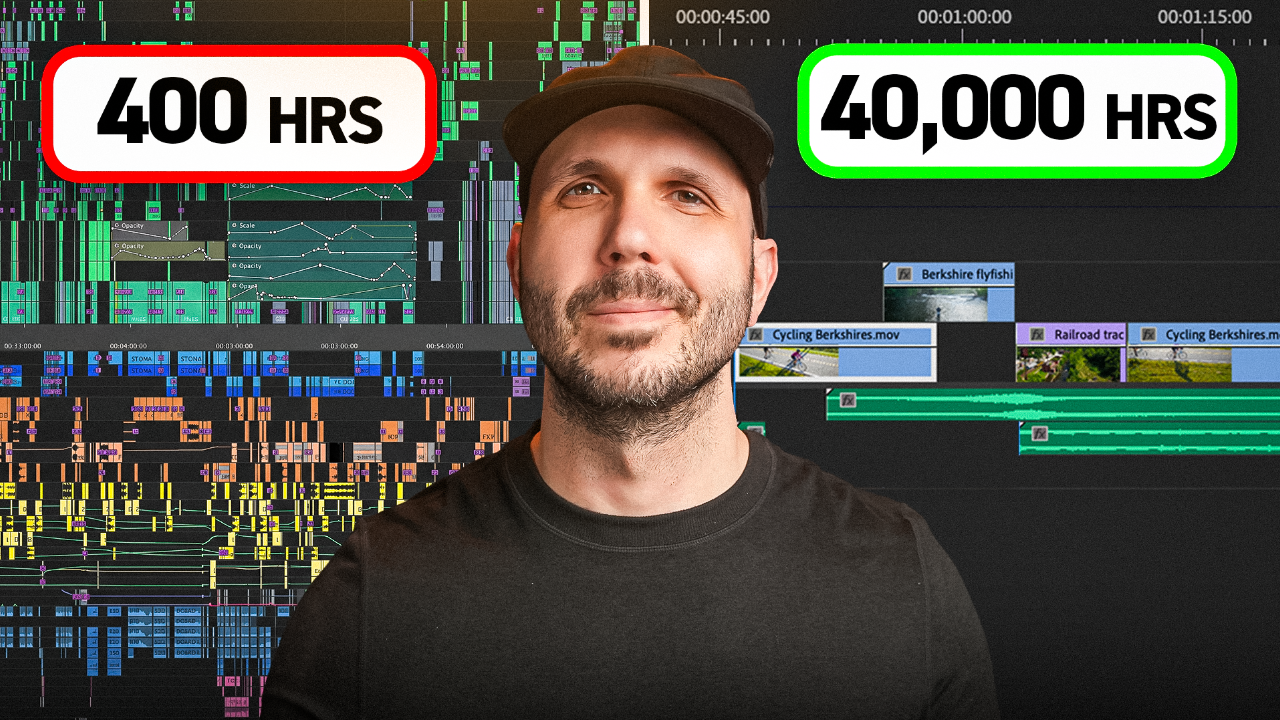
What do professional video editors know that beginners don't?
Professional video editors think in fundamentals, not effects. They prioritize emotion, story structure, rhythm, and sound design over flashy transitions or complex layering, and they treat feedback from someone ahead of them as the fastest way to grow.
After more than 40,000 hours editing, I've compressed everything I've learned into nine lessons. These aren't theory. They're the exact things that separate edits that land higher paying projects from edits that just sit there.
Why simple edits outperform complex ones
When I started out, I thought great editing meant more. More complex transitions, more video layers, more effects. I even spent months learning color grading, thinking it would set me apart. None of it made a real difference.
Then a mentor pulled me aside and told me I didn't need more. I needed to focus on the right things. When I look back at my most successful edits, most of them came down to one video track and a few tracks of sound design, emotion, story, and rhythm.
The more experienced you get, the more you realize it's all about the fundamentals. So lesson one is start being boring. Get back to what the best editors have been doing for decades and let those fundamentals do the work.
When done right, your simple edits using boring fundamentals will stand out more than any retention editing or edits with fancy graphics, and you'll start getting noticed to work on higher paying projects.
Why emotion should drive every editing decision
In his book In the Blink of an Eye, legendary editor Walter Murch shares his six criteria for successful editing, and emotion sits at the very top. It's not just number one. He gives it a weighting of 51%, making it more than all the other criteria combined.
When I started out, my emotional vocabulary was pretty limited. I thought maybe emotions were being sad or happy or excited or maybe angry. But the more you develop as an editor, the more specific you can get.
Instead of trying to make your audience feel happy or excited, aim for something more nuanced like calm, peaceful, satisfied, or safe. Instead of sad, think heartbroken, lonely, or empty. That level of specificity is really what separates edits that kind of work from edits that are truly successful.
Before you even touch your timeline, identify two or three moments in your edit where you really want the audience to feel something. For each one, pick a target emotion and be as specific as you can. Bonus points if you write it down.
So lesson two is pick specific emotional targets. Now you're editing with intention, so you'll know when something isn't working because you'll have a real target as your north star to measure against. I break this process down in more detail when I walk through how to edit for emotion using professional steps, which builds directly on this idea.
How story structure applies outside of feature films
A common misconception I run into all the time is that story structure only applies to narrative feature films. That's simply not the case. Audiences respond to conflict, rising action, character arcs, and resolution regardless of format.
I've used story structure to elevate work across talking head interviews, product demos, trailers, and even 15 or 30-second commercials. Here's a simple framework: something needs to change in your story about every 25% of the way through the edit. It doesn't have to be super dramatic. It can be a shift in tone or a new character. But if you get a quarter of the way through and nothing has changed, you'll start losing your audience because good stories are about change.
Before you start cutting, break your edit into four sections and ask what changes at each point. If you can't answer that question, you probably have a story problem, not an editing problem.
How rhythmic contrast creates emotional impact
Scientific studies show that different patterns of visuals can trigger different emotions. As editors, we have real influence over how our audience feels, and a lot of that runs through rhythm.
Here's my favorite way to use it. Establish a tempo in your edit, then at one of the points you picked out where you want to evoke a certain emotion, change the tempo drastically. In a scene from a short I edited, I went from around 10 cuts per minute to 33 cuts per minute. That contrast evoked a sense of urgency and excitement in my audience, which was exactly one of my emotional targets.
Once you've mastered rhythmic contrast, you'll never have to sit there wondering what to do when you want to draw out an intense emotion from your audience.
Why sound design should never be an afterthought
Early in my career, sound design was always an afterthought. I thought my job was picture editor, and a sound designer or mixer would handle sound later.
Then one day I brought a cut to my mentor, thinking it was polished. He watched it and simply said, "Let me watch it again but turn the music off." I had nothing else in there. No ambience, no room tone, no unique sound effects. Just that one music track. He was making the point that I was missing out on bringing out emotion with sound design itself, apart from the music.
Here's the four-step framework I use every day on broadcast TV commercials:
- Build your ambience, picking options that push your scene toward the target emotion
- Edit your dialogue and fill gaps with room tone so your cuts stay invisible
- Add specific sound effects for key moments that bring the shot to life
- Add music last, once everything else is locked in
Your edits will start hitting those emotional targets that visuals alone will never reach, and suddenly the clients who were looking you over will start to take notice. If you want a shortcut for finding the right sounds fast, the Sound Effects Search Terms Guide gives you a proven glossary so you always know what to search for.
How to search for music without wasting hours
In my 20-plus years as a pro, nothing wastes more time than searching for the perfect music track. Over time I developed a music search process that cuts my search time in half almost every time.
Before you start any music search, decide what your emotional target is for the audience and write it down. From there, work through four more questions:
- What genre best fits that emotion?
- What instrumentation within that genre brings out that emotion best?
- What tempo matches the rhythm of your edit?
- How many instruments should be in that track?
Not only will this save you time, you'll start using music tracks that actually bring out your target emotions, and your edits will land with the audience.
Why matching on action limits your edits
Most editors, when they're starting out, learn matching on action as one of their first cuts. I think editors go to it way too often. My problem with matching on action is you're limiting your editorial options.
Walter Murch offers a better alternative he calls nodal editing. Nodal meaning parts or pieces. The idea is that each shot contains its own distinct action. I let the action complete before cutting to the next shot, which lets me pick the length of the shot and establish the emotional rhythm of the scene.
Instead of letting the footage decide where you cut, you choose based on what emotions you're trying to evoke in the audience.
Why transitions matter more than the cuts themselves
Most editors think editing is about cutting scenes. The more experienced you get, the more you realize it's really about how you connect them. Here are three transitions I use that make edits stand out.
In Treasure Imagination, we used a match cut to go from the city to a cave by cutting on the action of a boy's hat coming down in one scene and back up in the next. It made a jarring location change feel elegant.
Then there's a smash cut with sound carryover, where you cut on the energy of an action and let the audio from the first scene drop you into the next. And there's a sound advance, or J-cut, where you hear the audio of the upcoming scene before you see it. Later in the same film, a car horn from the waking up scene plays while the boy is still in his dream.
Once you're able to seamlessly take your audience from one scene to the next, your edits will be way more successful.
Why finding a mentor is the real shortcut
I spent four years trying to learn editing on my own and I could not book a gig. I equated editing with software at the time. I was getting faster, learning shortcuts, but I wasn't learning the things that mattered most.
Everything changed when I found a pro mentor who taught me real techniques and gave me feedback on my actual edits. The one true shortcut to having a fulfilling career as a pro editor is finding someone ahead of you at a level you aspire to who will give you feedback on your work. It doesn't have to be me, but find one. I promise it will save you years.
You don't know what you don't know. Getting outside feedback is exactly how you stop repeating the same mistakes, which is something I walk through in more detail when I talk about how professional video editors use feedback to perfect projects.
If you want to work directly with me to create emotionally impactful edits that land higher-paying projects, you can check out Edit Like A Broadcast Pro, where I help you craft edits that win serious clients with real budgets.
