
How to edit for rhythm like Matthew McConaughey taught me
How do you edit for perfect rhythm and timing?
Perfect rhythm in editing comes from respecting the natural cadence of performance and understanding that every single frame affects the flow. Professional actors like Matthew McConaughey protect their delivery timing because it's essential to the emotional impact.
The power of watching actors work
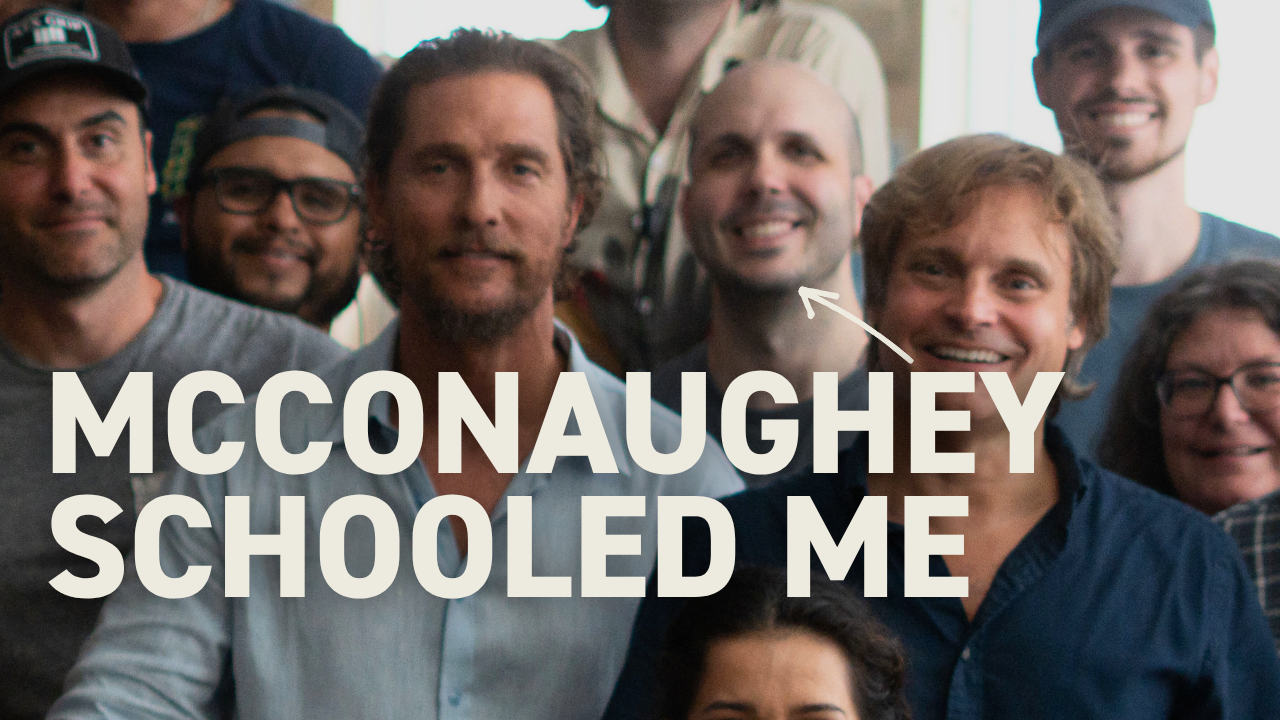
Last summer, I got a call to work on a project for Matthew McConaughey's Just Keep Livin Foundation. They were launching a program to help schools apply for federal safety grants. I was brought on to edit the project and also asked to be on set as script supervisor.
While someday I hope to edit an actor of McConaughey's caliber in a narrative context, even on this PSA, I learned so much from watching him work.
As script supervisor, I get to hang out near the monitor. After director Scott Rice and Matthew would get a take they liked, Matthew would come over to the monitor to watch playback. I noticed as he watched a take, he would move his hands almost like a conductor, really feeling the rhythm of his performance.
If something felt off, he would ask for another take.
Why rhythm matters more than you think
Once I started editing, the cadence of Matthew's delivery and the care he had taken to achieve it really stood out to me. There's a section of the PSA where he explains the initiative in voiceover while animation plays on a chalkboard.
Given the time constraints of a 90-second PSA, I had to manipulate the timing a bit and speed up Matthew's voiceover delivery, cutting out a few frames here and there.
When it came time to give notes on the edit, Matthew noted that between a couple of the lines, it felt like a beat was missing. Sure enough, I went back and checked my timeline and I had indeed cut out three frames between two of his lines — but that was enough to throw off the rhythm of his delivery.
Understanding how professional video editors think about emotion first becomes critical when you realize that rhythm is often what carries that emotion forward.
Every frame counts in professional editing
I added the frames back per his feedback and it made it better, more natural, and as he intended. Between the care Matthew took on set with his cadence and the fact that he still had those rhythms in his head while watching the rough cut, it reinforced to me the importance of rhythm in performance and editing.
Three frames. That's 1/8th of a second at 24fps. But it was enough to disrupt the flow of his entire performance.
Think Like A Broadcast Editor and discover the 5 criteria top editors use to craft emotionally-impactful edits — including how rhythm affects emotional response.
What this means for your editing workflow
This experience was a great reminder that excellence is found when you drill into those details and finesse your edits down to each frame. It's not just about making cuts that work — it's about making cuts that preserve and enhance the natural rhythm of the performance.
Most editors rush through timing adjustments without considering how they affect the overall flow. But when you're working with professional talent, especially actors who understand rhythm as deeply as McConaughey does, every micro-timing decision matters.
The lesson isn't that you need to obsess over every frame in every edit. It's that you need to develop an ear for when rhythm feels right and when it doesn't — then have the technical precision to fix it frame by frame.
If you're serious about taking your editing skills to the next level and learning how to craft edits that resonate with audiences and clients alike, Edit Like A Broadcast Pro will teach you to create emotionally-impactful edits that win serious clients with real budgets.
