
How to Fix an Edit That Feels Wrong: A Real Commercial Review
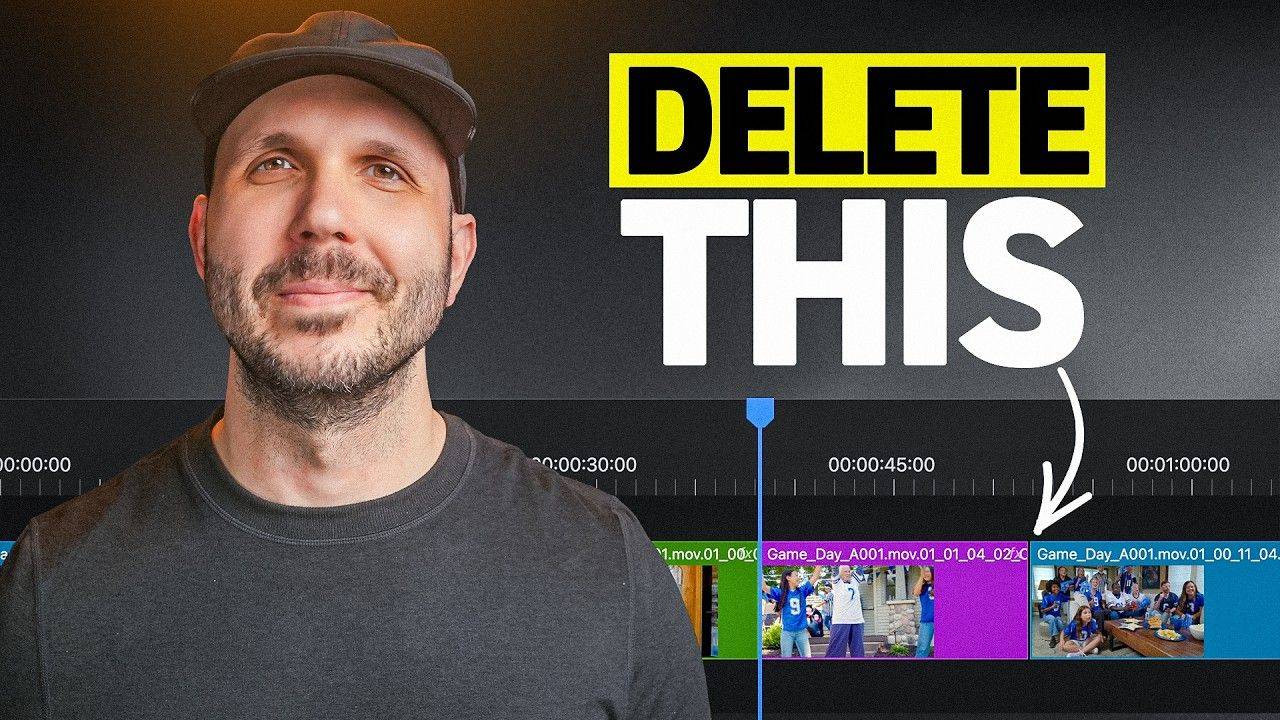
How do you fix an edit when you know something is wrong?
Start by asking what you want the audience to feel. Then check every shot choice, the order of the shots, the rhythm, the sound and your in and out points against that one goal. I've cut broadcast TV commercials for over 20 years, and this is how I spot problems fast. Below, I walk through it on a real commercial a subscriber sent me.
The first thing I look for: the target emotion
Four years into my editing journey, I could not land a single gig. Then a mentor taught me something that launched my career. Editing is not a technical exercise. It's all about evoking emotion in the audience.
Legendary editor Walter Murch agrees. He weights emotion as 51% of any edit.
So let's put that to the test. Bud is a subscriber to my email list, and he owns a video production company. He sent me a credit union commercial he cut, all about game day and tailgating.
What emotion is it going for? I'd say energy, with some comedy. So every note below is about one thing: how to hit that target harder. I look at four things, in this order:
- Story: what shots he chose, and when
- Rhythm: the pattern of shot lengths
- Sound: what each shot sounds like, and what the sound and music tracks are doing
- Action: where he cuts in and out of each shot
If you want the full version of this way of thinking, I break it down in the ESRA framework: emotion, story, rhythm and action.
The opening shot: sync the reaction to the sound
The spot opens on a whistle. To me, the actor didn't react fast enough, and his eyes didn't open wide enough to feel startled. I might come into the shot a little later, or bring the whistle in a little later. I don't know what footage Bud had, but I would have searched hard for a take where he looks truly startled, so it syncs up with that sound.
If you want to go deeper on emotional storytelling, grab my free guide, Think Like A Broadcast Editor. It walks you through the 5 criteria top editors use to craft emotionally impactful edits.
Rhythm: cut out when the action ends
Next is a guy doing push-ups. The action of that shot ends when he hits the top of his push-up. Frame by frame, he stays at the top and even starts coming back down. So I'd cut out a little earlier.
That's a rhythm note and an in and out point note. Bud is building a fast montage, and the target is energy and comedy. Tightening shots like this keeps that energy up.
A few shots later, the rhythm breaks. After a quick-cut montage, one shot holds almost twice as long as the pattern he set. It felt too long.
Story: make sure every shot says something
That long shot has a story problem too. The joke is that a guy is brushing his teeth while holding a big foam finger. With this shot choice, the joke didn't quite land for me.
Here's a fix that solves both problems. Split it into two shots: show him brushing his teeth, then cut wide to reveal the foam finger. The joke gets clearer, and two shorter shots keep the pace he built.
The next shot confused me. A guy holds a package, opens his door, and a doorbell rings. Is he getting a package? Running an errand? In a 30-second commercial, I ask this about every shot: what is this shot doing, and what is it trying to say? When I don't understand a shot, I either swap it out or cut it, and give that time to something that pushes the story forward. The audience's time is valuable.
Then there's the idea of economy of storytelling: how few shots can you use to tell the story? One shot showed a card reader beep, a nice use of sound design with clear action. But I'd just seen him pay two shots earlier, so it felt like a repeated idea. I'd remove it, reorder it or put something else in its place.
Action: where to cut in and out
The convenience store shot tells a much clearer story. Two guys walk toward camera with tons of snacks. It reads nicely.
Here's my rule for in and out points: I cut in when an action starts, and I cut out when an action finishes. In this shot, the man looks down, takes a step, and then they look over at each other. That look is a clear action ending. Bud stays on a few extra frames, so the man's face starts turning back to camera. That's a new action starting right before the cut, and it makes the edit feel less polished. I'd cut out right on the look over. For more on this, here's how I decide where to cut every shot.
Comedy loves tight cuts too. In one funny shot, I focused on the woman in white. The first few frames, before she starts her action, slow things down. So I'd cut in when she starts raising her arm, and cut out when she's fully extended, before she brings it back down. Two little trims, and the moment gets funnier.
There's one place I'd break my own rule. Bud has a cool graphic match of a guy catching a football across two shots. He finishes the catch in the first shot, then starts the second shot with the ball already in hand. Here, a match on action can sell the illusion. I'd cut out of the first shot while the ball is still in the air, and cut into the second shot while it's still in the air, so the catch completes across the edit. That bridges the two ideas with a cut. If you want to know when each type of cut fits, read nodal editing vs match on action.
Sound: commit to a choice
The sound design felt a little uncommitted. Either the montage is all music driven, or you commit to hearing the natural sounds of the environment. I lean toward the second one, with more sounds.
The grilling sound didn't match the picture. It sounded a little fake, maybe too loud in the mix. I'd look for subtler grilling sounds. I'd also check for production audio of the guys talking, so I could mix it low and let us hear the environment.
When a guy digs into a cooler, I'd add the sound of ice. We all know that sound.
For the ending, I like the voiceover, the music Bud picked and the final shot. But sound design could push the energy further. I can see a big crowd and hear a little cheering. I'd plus it up with extra cheering sound effects, maybe even big crowd cheers, to make it feel larger than life. That's the feeling of college game day. And as an ad, that's the goal: the audience connects that emotion with the product.
Overall, Bud did a really good job. These are small tweaks, and every one of them is about hitting the target emotion.
Get notes like these on your own edits
I do reviews like this every morning inside Edit Like A Broadcast Pro, my editing mentorship. You'll get notes and feedback on your edits while we build a showreel that wins serious clients with real budgets.
