
How to sound design for emotion using 5 professional steps
How do professional video editors use sound design for emotion?
Professional video editors target a specific emotion first, then use ambience, dialogue placement, music, and sound effects to reinforce that feeling throughout the scene.
Stop diving into sound design without an emotional target
Most editors make the same mistake I made early in my career. They dive right into a scene, start using various techniques, but without a clear goal in mind.
That was me my first few years as an editor. It wasn't until my first mentor showed me that editing is all about emotion and story that my editing changed and it kicked off my career. And that's exactly what we need to do here, even with sound design.
So stop diving in without a plan. Instead, decide on a target emotion for your scene first. Then use all of your editing skills and technique to reinforce that emotion.
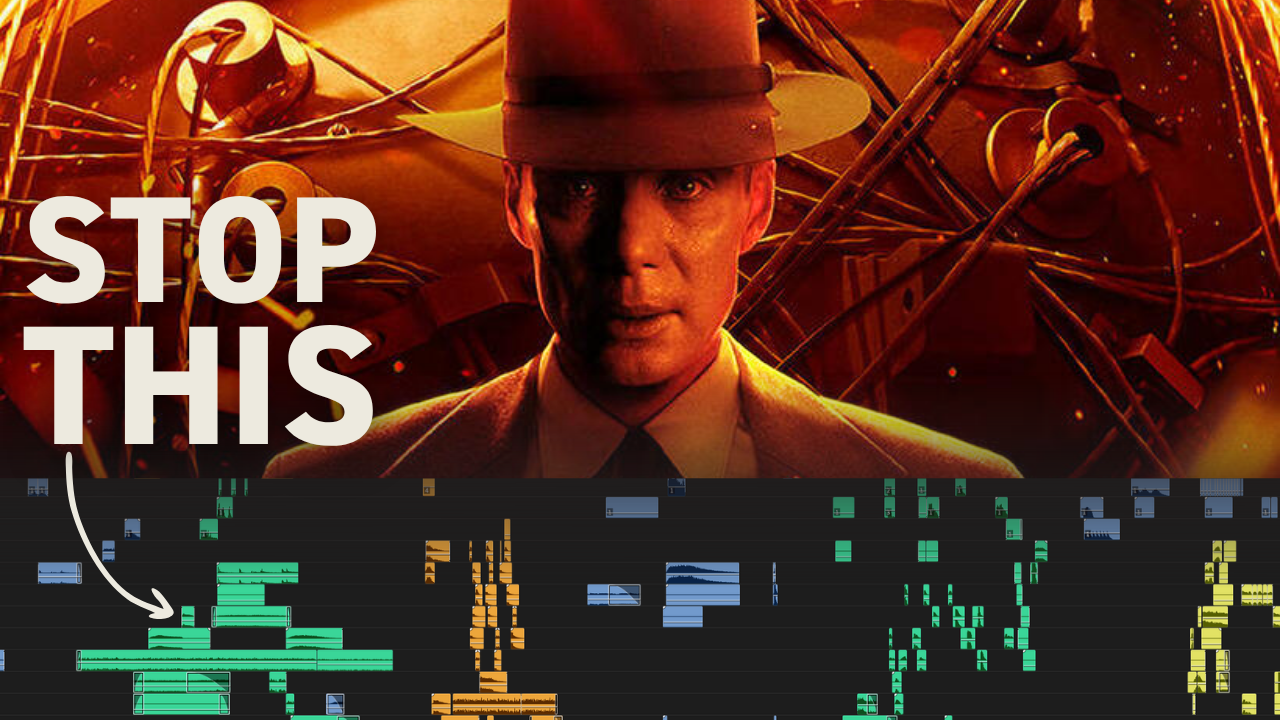
Take this Oppenheimer clip. Watch editor Jennifer Lame's approach:
"3 years, 4,000 people, $2 billion. If it doesn't go off, we're both finished. I'm betting on 3 kilotons. Anything less, it won't get what it is. What did Fermi mean by atmospheric ignition? Well, we had a moment where it looked like the chain reaction from an atomic device might never stop, setting fire to the atmosphere."
This scene targets pure tension. The techniques matter, but only because of what they make us feel.
Build your emotional foundation with background ambience
I always start with background ambiances because it provides a nice bed for the dialogue to sit in and it sets an emotional tone.
Too many editors when they're starting out just use the production audio they're given. But if you really want to elevate your scene, you need to find those background ambiances that really elevate that emotional target.
In the Oppenheimer scene, it's raining, so the background ambiance is a rainstorm. But I guarantee you, they didn't just pick any thunderstorm. They auditioned hundreds of different sounds to find the one that brought out the most tension.
Don't settle for what's already in your timeline. Try a few different background sounds and pick the one that pushes your scene toward the emotional target you picked in step one.
This approach is critical when you're working on commercial projects, where every sound choice needs to serve the emotional story.
Push and pull dialogue placement for emotional impact
Feel free to push and pull the placement of the dialogue, especially if it's not shown on screen. Need more energy? Tighten it up. Need more introspection? Add space.
In the Oppenheimer clip, the conversation moves really fast. Odds are the actors didn't deliver their lines at this speed on set.
Take these two lines: "What did Fermi mean by atmospheric ignition? Well, we had a moment where it looked like the chain reaction from an atomic device might never stop."
My guess is that it was trimmed in the edit because there's only an eight-frame pause between the two lines.
Here's another tip. When I started editing, I used to always pick the cleanest takes from actors or voiceover artists, and I would throw away the takes with little imperfections. But later in my career, I realized that sometimes it's those little vocal nuances or vocal quirks that make a performance seem authentic.
Just like this line from Matt Damon: "What did Fermi mean by atmospheric ignition?" Did you catch the little mouth noise he made before he delivered his line? I think that really brings authenticity and builds tension as well.
Get the Sound Effects Search Terms Guide to discover the proven sound design glossary that helps you instantly know what to search for—so your edits sound better, faster.
Save music for after you build your emotional base
You might be wondering why we haven't talked about music yet. I like to build the emotional base with ambience and dialogue first.
Since music is so powerful when it comes to emotion, I find that if I start with it in my timeline, it can sometimes trick me into thinking I've hit all my emotional targets when really I haven't done everything I can yet. So I like to get my ambience and dialogue working first and then I shift to music.
I think we often dive into a music search without a clear goal in mind. I'm guilty of this myself. We get overwhelmed, we lose our way, and it can be really frustrating.
Imagine starting your search with an emotional target in mind like tension. Maybe you're searching in a music library where you can filter by instrumentation and you choose orchestral score. Now you have direction.
Add specific sound effects that amplify your target emotion
Just like with background ambience, don't settle for sound captured on set. Ask yourself, what specific sounds can I add to amplify the emotional target?
In the Oppenheimer clip, you can hear the subtle rustle of clothes as the character gets up. In addition to the thunderstorm and rain ambiances, there are strategically placed thunder claps that fit perfectly between two lines of dialogue: "We're both finished. I'm betting on 3 kilotons. Anything less, we won't get what it is."
These tiny details make the world feel real, and the quality of the sounds themselves add to the tension.
Go through clip by clip in your next edit and ask yourself, is there a sound I could add or swap out to elevate my target emotion? Even if a sound was recorded on set — like a door knock — it might not hit the emotional target you're going for. You might want to try replacing it with a sharper knock or a harder knock depending on the mood you want.
Experiment until each sound hits those emotional marks. Now you know how to craft sound design that makes your scenes hit hard emotionally.
Work with me in Edit Like A Broadcast Pro to create emotionally-impactful edits that win serious clients with real budgets.
