
How Professional Video Editors Cut Commercials: McConaughey Case Study
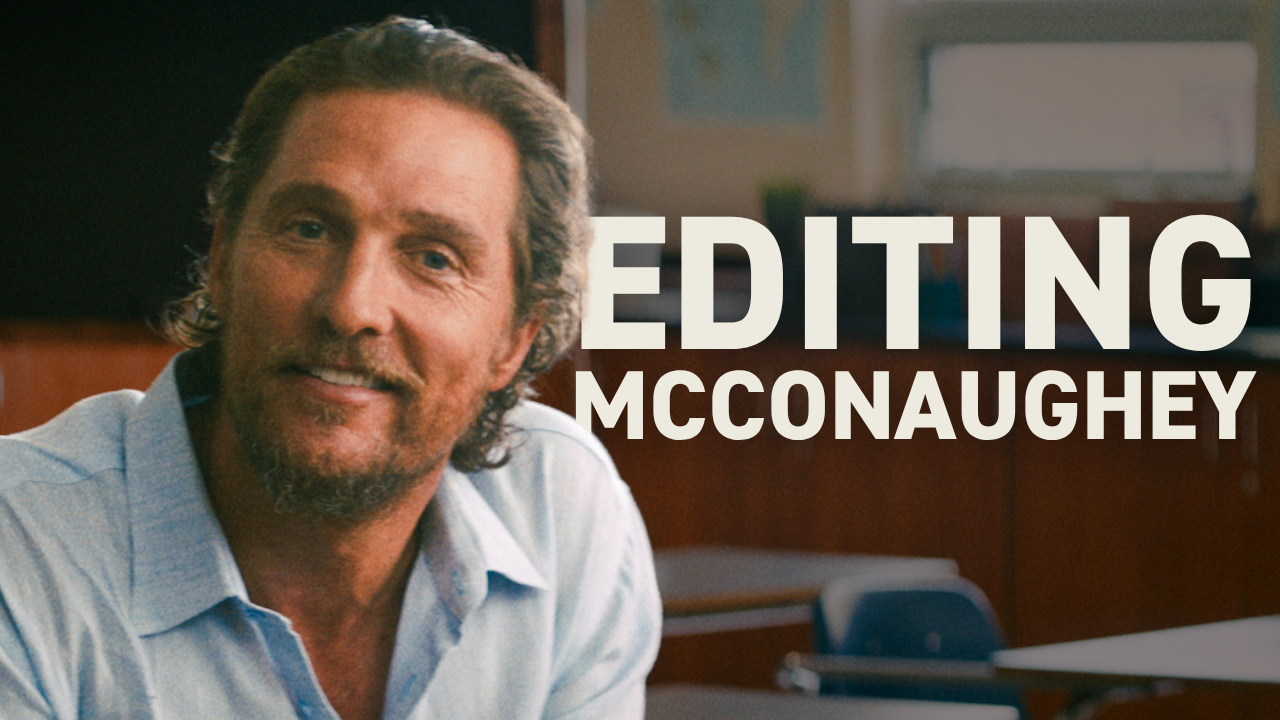
How do professional video editors approach cutting high-end commercials?
Professional editors use five core criteria when cutting commercials: emotion, story, rhythm, sound, and action. These elements work together to create impactful edits that serve the message while maintaining viewer engagement throughout complex narratives.
The Foundation: Editing for Emotion First
Emotion isn't an editing technique — it's the foundation for every other decision you make. If you play a musical instrument, you probably learned your scales. That's technique. But when you get together with a band, you don't just play your scales. Hopefully, you play to serve the emotion of the song.
I like to think of editing the same way. When I first read this McConaughey commercial script, I was struck by the inspiring message. The ending really packs an emotional punch, but there was also lots of information to convey.
For the first two-thirds of the piece, I wanted the audience to have a sense of understanding and curiosity. For the last third, I wanted them to feel inspired to take action.
Download the free Think Like A Broadcast Editor guide to discover the 5 criteria top editors use to craft emotionally-impactful edits.
Building Story Structure in Commercial Editing
While this isn't a narrative, there's definitely a story structure to this commercial. Act One is where Matthew states the ordinary — there's federal funding available for school safety — and he states the problem: schools are having trouble accessing these funds.
Then in Act Two, Matthew explains how schools can access the funds. In Act Three, we have an emotional climax that inspires the audience to take action.
One of my favorite aspects of this commercial is how director Scott Rice used different locations to reinforce the story structure. Act One takes place in front of the school and in the hallway. Act Two takes place in front of the chalkboard. Finally, Act Three takes place at the students' desks.
Professional video editors understand that story structure drives every edit decision, even in commercial formats.
Rhythm and Pacing for Information-Dense Content
I wanted this spot to have a steady, brisk pace because there's a lot of information to convey in a short amount of time. The rhythm decisions start with the very first frame.
You'll notice that I only let one frame go by before Matthew begins speaking. If this were expanded to six frames or even 12 frames, that would establish a totally different feel.
Critical Rhythm Decisions Throughout the Edit
The next edit is a good example of how in and out points help define the rhythm. As Matthew transitions from the hallway to the classroom, I cut out of the shot before he fully leaves the frame. This adds to the energy of the transition.
For the smooth transition from Matthew standing to sitting, my out-point is Matthew preparing to sit with his hands on the desk. Then the in-point of the next shot is the full sitting motion.
Sound Design That Serves the Story
This spot is obviously music-driven, but we have sound design elements at the beginning — birds chirping and students talking. The level of students talking increases as we enter the hallway.
At the transition from Act One to Act Two, we have sound elements that really help it along. There's a school bell ringing as if class is in session, and then a nice music edit that gives us a burst of energy into the next scene.
The subjective whoosh sound helps elevate the whip-pan transition, and then there's detailed sound design during the animation sequence.
Action-Based Cutting for Professional Results
The action of shot one is when Matthew begins speaking. The cut from shot one to shot two is a J-cut, where the audio comes in before the visual. This helped tie these two shots and locations together as they're both part of Act One.
The action I cut out on in shot one is Matthew turning his head. The action I cut in on in shot two was Matthew beginning to speak.
Motivated Cutting for Maximum Impact
The cut from shot two to shot three goes from a medium shot to a close-up — sometimes called a punch-in. Here's a quick tip: when you're cutting in, make sure it's motivated. In this case, we wanted to emphasize this line. It's almost like saying to the audience, "Hey, let's get closer, this is important."
After being on the chalkboard for a time, we knew going back to Matthew would be an opportunity for an impactful moment. We deliberately came back to him for the line, "to schools. That's right, it's free."
The last edit of the spot is from Matthew to the art card. This is important because it's the last image of Matthew you're leaving in the audience's mind.
The Most Important Lesson: Preserving Performance Rhythm
In addition to editing, I got to be on set, so I got to see Matthew in action. I noticed after he would do a take, when he was listening back on the playback monitor, he was paying particular attention to the cadence and rhythm of his performance.
I had an epiphany: rhythm and cadence are a huge part of how authentic a performance feels. So, as an editor, I want to do my best to preserve that cadence established on set, especially when it's an actor of Matthew's caliber.
This approach transforms how you think about every cut. You're not just connecting shots — you're preserving the authentic rhythm that makes a performance feel real.
If you're ready to master professional commercial editing techniques, check out Edit Like A Broadcast Pro to create emotionally-impactful edits that win serious clients with real budgets.
