
How Professional Video Editors Cut Commercials: 5 Key Criteria
How do professional video editors approach cutting commercials?
Professional editors use five key criteria when cutting commercials: emotion, story, rhythm, sound, and action. These criteria work together as a framework for making editing decisions, with emotion serving as the North Star that guides all other choices.
The Emotional Foundation: Making Every Cut Count
When a commercial script lands on my desk, emotion is the first thing I consider. It's not an editing technique—it's the foundation for every other decision I make.
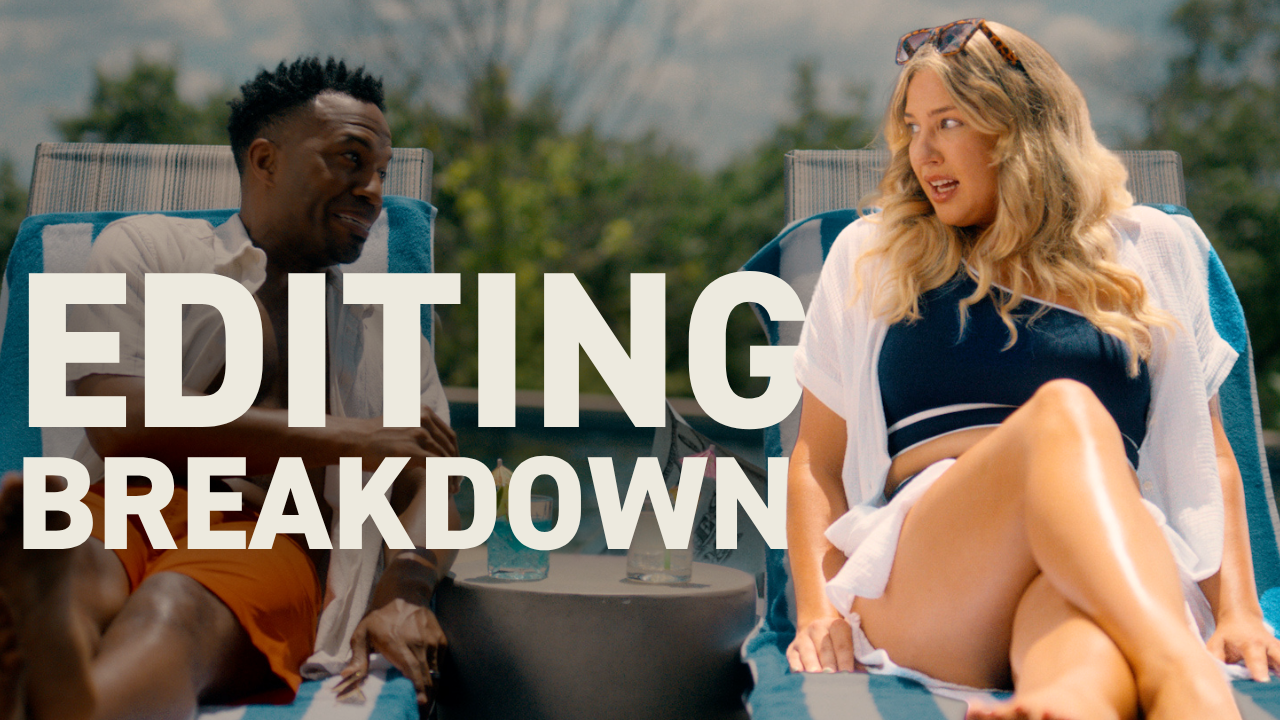
For a recent credit card commercial I edited, the emotional goal was clear: make the audience laugh. The comedy came from juxtaposition—a couple relaxing on vacation while their $50 bill does all the work, struggling to shade them from the sun.
From the outset, I decided to do whatever I could to highlight that juxtaposition. There's also physical comedy as the bill balances on a ladder, struggles, and eventually falls. My emotional North Star was simple: get a laugh, or at least a smile, by emphasizing the contrast between relaxation and struggle.
Want to master the emotional foundation of professional editing? Get the Think Like A Broadcast Editor guide and discover the 5 criteria top editors use to craft emotionally-impactful edits.
Story Structure in 30 Seconds
Story works on two levels in commercial editing. You have shot-to-shot storytelling—how any two cuts tell a story together—and the underlying structure of the entire piece.
For shot-to-shot storytelling, I focused on specific moments. We cut from a close-up of the woman relaxing to the bill in a wide shot. Later, we cut from the woman asking for help to a close-up of the exasperated bill. These cuts create narrative connections.
The commercial doesn't have complete three-act structure, but it has key elements. The opening shot establishes our "ordinary world." Then we get a complication: the woman wants shade. Rising tension builds as the bill struggles, leading to a climax where the bill falls. The ending provides resolution—or purposeful lack of it.
Single-Track Editing for Better Rhythm
One tip for editors working on rhythm: try single-track editing. All my video clips sit on one track, color-coded for clarity. When I look at my timeline, I can see the rhythm immediately.
This commercial has nice rhythm throughout, with a point of rhythmic contrast where I shift from one rhythm to a faster one—right when the bill falls from the ladder. This was intentional. I wanted to add intensity to the fall.
Sometimes I use rhythmic contrast to make a point. Other times I want rhythm to be invisible, like a great bass player. You might not notice the bass in the mix, but if you removed it, the song would fall apart.
Sound Design That Expands the World
Sound design plays a crucial role in this commercial. At the beginning, there's the sound of someone diving into a pool off-screen. Using sounds of things happening off-screen increases the size of your world without showing it.
We have a tropical soundtrack for vacation vibes, plus subtle seagulls and waves for ambience. This relaxing world contrasts with the bill's struggle—we hear the ladder creak as he tries to balance and his exasperated sigh.
Later, we add comedy with body impact sounds when he falls and dishes breaking. One of my favorite juxtapositions comes at the end: the bill begrudgingly climbs back up while the man takes a loud sip of his drink.
Cutting on Action for Seamless Flow
Where you cut matters enormously. In the opening, the woman begins looking around in shot one and finishes in shot two. I use her lips closing as the out-point, then reveal the wide shot of the bill.
In the wide shot, I focus on the bill lifting his left leg, cutting out after his body settles. Then we cut to a close-up, starting with the eye roll and cutting out after he glances at the woman—a classic glance-object cut.
The falling sequence uses match on action: the bill starts falling in close-up and finishes in the wide shot. For the final button joke, my in-and-out points focus on the man picking up his drink and taking a sip.
One quick tip for comedy: cut things tight. On the man sipping his drink, I cut right on the frame he finished—or even interrupted the sip by a couple frames. This helps make the joke pop.
The Reality of Professional Commercial Editing
Here's something about the commercial editing process you probably haven't heard: this wasn't my first try. When I went back and looked at my project file, this was sequence 34. I tried 34 different variations before landing on this version.
More importantly, I got feedback on those 34 versions with trusted collaborators—the director and creative directors. We landed on what we thought was the most impactful version of the edit.
That's how professional commercial editing workflow actually works. It's not about getting it right the first time. It's about iteration, collaboration, and using these five criteria as your guide through dozens of versions until you find the one that works.
Ready to master these professional techniques? Edit Like A Broadcast Pro will teach you to create emotionally-impactful edits that win serious clients with real budgets.
