
How Professional Video Editors Break Down VFX Commercial Projects
How do professional video editors handle complex VFX commercial projects?
Professional editors break down VFX commercials into distinct phases: string out organization, picture lock with invisible elements, facial capture integration, and final delivery coordination. The key is editing audio-first since visual effects don't exist until after picture lock.
String Out Organization Sets the Foundation
After importing and syncing all raw footage, I organize everything in one long sequence called a string out. I arrange it in story order and use screenshots, labels, and markers to navigate quickly between shots and takes.
Here's a workflow tip that saves time: organize takes from last to first. The shooting process naturally improves as directors give notes, cameras get dialed in, and actors find their rhythm. The last takes are usually the best takes, so that's where I start.
Another critical habit — watch for usable frames before "action" and after "cut." Every piece of recorded media is fair game for your final edit. Those extra frames will save you when you need them most.
Once the string out is complete, watch through it two to three times while taking notes. If you're well organized and familiar with all the raw footage, you're already 70% of the way to a great edit.
Picture Lock with Invisible Elements
The biggest challenge with VFX-heavy commercials is editing invisible action. The visual effects process doesn't start until after picture lock, so you're cutting around elements that don't exist yet.
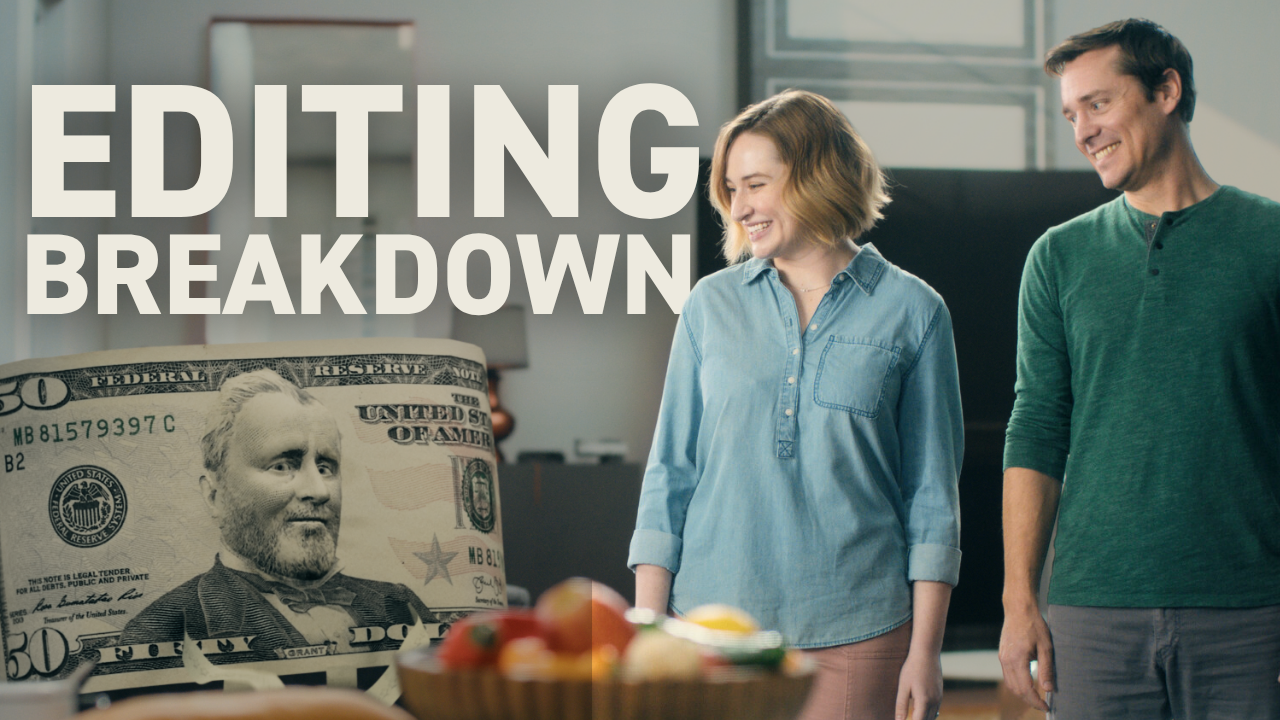
For this America First Credit Union spot, the main character was completely 3D animated. I had to edit the entire commercial around an invisible character interacting with real actors.
One trick that saved this project: cut with the visuals turned off, like you're editing a radio spot. If the pacing and performance work in audio alone, you know you're on the right track.
I also do the reverse — edit with audio turned off to check rhythm, pacing, and in-and-out points without being influenced by dialogue. When both audio and visuals stand alone, combining them creates something solid.
Facial Capture Integration
Once we locked the voice performance, we brought in a performer to record facial expressions while lip-syncing to the final audio. These facial captures let us build out the edit and gave our 3D animator a head start on facial expressions and dialogue.
I used the motion panel and keyframes to move facial captures around, simulating the blocking of the final scene. This gives everyone a visual sense of how the final VFX will look and play out. Don't skip details like this — they matter for the final result.
The professional video editing workflow for VFX projects requires constant communication between departments and clear visualization of invisible elements.
Final Animation and Color Pipeline
When the 3D animation arrived, we moved back into log color space for maximum flexibility in color grading. Our animator delivered the animation in multiple layers — background plates, character elements, and interactive objects on separate tracks.
By delivering multiple layers, the colorist gets tremendous flexibility. In earlier cuts, I used a LUT (lookup table) to convert raw color space into something more standard for review, but final delivery requires the full dynamic range.
Understanding how professional video editors craft smooth edits that flow becomes even more critical when coordinating multiple VFX elements and ensuring they integrate seamlessly with live action footage.
Final Delivery Coordination
Final delivery brought together the complete post team. My sound design was replaced with a stereo sound mix from re-recording mixer David Beede. VFX shots became final color renders from colorist Brandon Thomas. Final graphics were composited over the color-corrected animation.
This America First spot required coordination between the editor, 3D animator Greg Alalu, colorist Brandon Thomas, and sound mixer David Beede. Each department's work builds on the previous phase, so clear communication and organized handoffs are essential.
The final result demonstrates why breaking down complex projects into clear phases works. From string out organization through picture lock to final delivery, each step serves the next. When you understand how to manage professional editing workflows for commercials, you can handle any VFX project that comes your way.
