
How to Use Three Act Story Structure in Video Editing
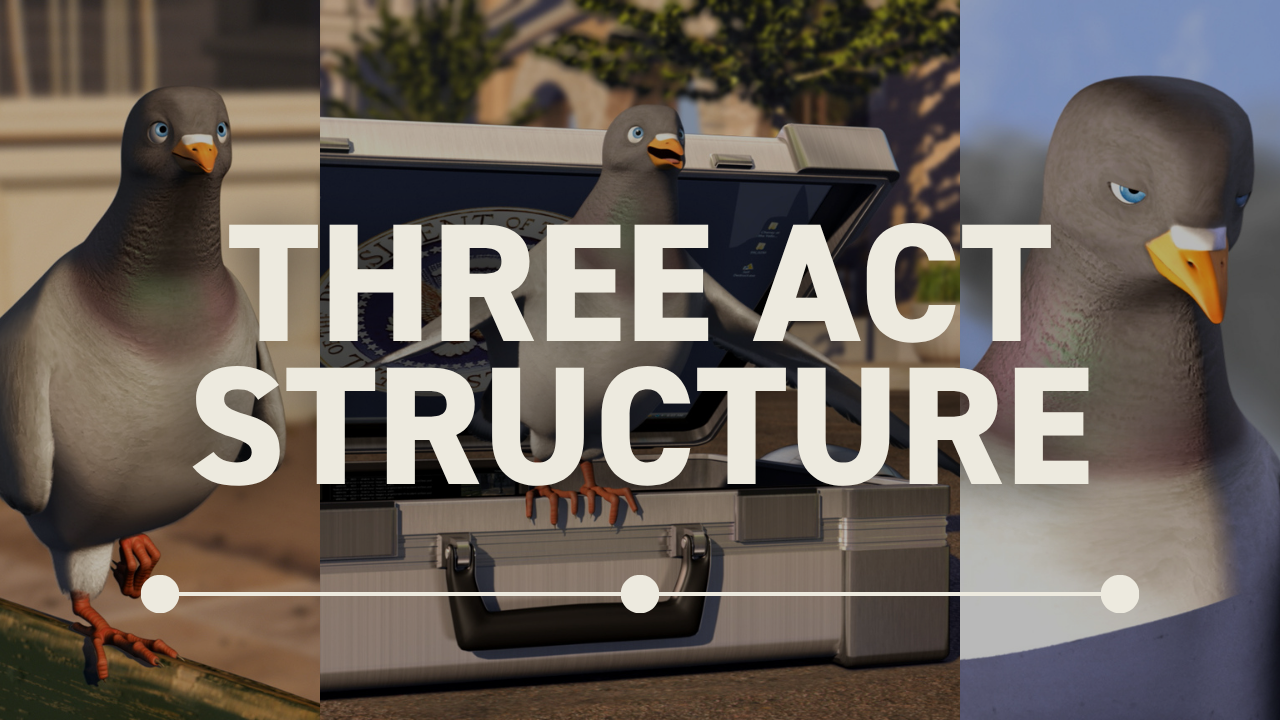
How do you apply three-act story structure in video editing?
Three-act story structure divides your story into precise segments: Act I takes 25% of runtime, Act II takes 50%, and Act III takes 25%. This framework works for any project — from commercials to documentaries — because it mirrors how audiences naturally process information and emotion.
The acclaimed short film Pigeon: Impossible demonstrates this structure perfectly in just six minutes.
Why every editor needs to understand story structure
A deep understanding of narrative story structure is one of the most important tools in an editor's tool belt. Even if you're not actively editing a narrative, these concepts can be applied to almost any project.
For those who want to rebel against Hollywood story structure, do so at your own risk and only after you learn the rules you're interested in breaking.
Breaking down the three acts
When dividing your story into three acts, the timing is crucial. In the case of a six-minute short, Act I should take about 90 seconds, Act II should take about three minutes, and Act III should take the final 90 seconds.
Let's examine how Pigeon: Impossible executes this structure.
Act I: Setup (25% of runtime)
The opening of a narrative film should reveal the protagonist and show them in their normal environment. Here we meet Walter — clearly not the most suave of all the agents.
Within Act I, you have the inciting incident where the main character's normal world is disrupted. In this case, it's when a seemingly harmless pigeon appears.
Then comes the first plot point, which should send the story in a whole different direction. Here, it's when the pigeon gets trapped in the briefcase. This happens at the 1.5-minute mark — exactly 25% of the way through.
Act II: Confrontation (50% of runtime)
This leads into Act II, where the protagonist tries to solve the problem, but things continue to escalate and get worse for them.
A key element of Act II is the midpoint — where the character thinks they have the problem solved, but it ends up only getting worse. In Pigeon: Impossible, this is where the tables are turned. Walter's in control and he threatens to destroy the bagel. We're right around the three-minute mark — exactly halfway through the film.
As the stakes continue to rise, we get to the character's lowest point, sometimes referred to as the "big gloom." For Walter, his lowest moment is when it appears he might be responsible for starting World War III. Walter must shed his insecurity and muster up the courage to save the day.
If you want to understand how professional video editors think about emotion first when crafting these story beats, you'll need to consider the audience's emotional journey, not just the plot points.
The beginning of Act III hits right at around 75% — perfectly timed.
Think Like A Broadcast Editor guide shows you the 5 criteria top editors use to craft emotionally-impactful edits that follow these structural principles.
Act III: Resolution (25% of runtime)
In Act III, the rising action comes to a climax. This happens when Walter outsmarts the pigeon and destroys the nuke, saving the day.
Also in Act III is the resolution, or denouement. This is when Walter comes back down to earth — literally — and things are back to normal, but he's a changed man. He is no longer a bumbling agent; he has swagger. And the pigeon? Well, he gets what he deserves.
The editing challenge behind the structure
While this structure is simple, it's not easy. The story was refined over several years before the animation team brought it to life. That's the reality of professional editing — the framework provides the skeleton, but the craft lies in the execution.
Whether you're cutting commercials, documentaries, or social media content, these same principles guide how you reveal information, build tension, and deliver satisfying conclusions. The timing ratios might shift, but the emotional beats remain constant.
Edit Like A Broadcast Pro course teaches you to create emotionally-impactful edits that win serious clients with real budgets using these structural foundations.
